
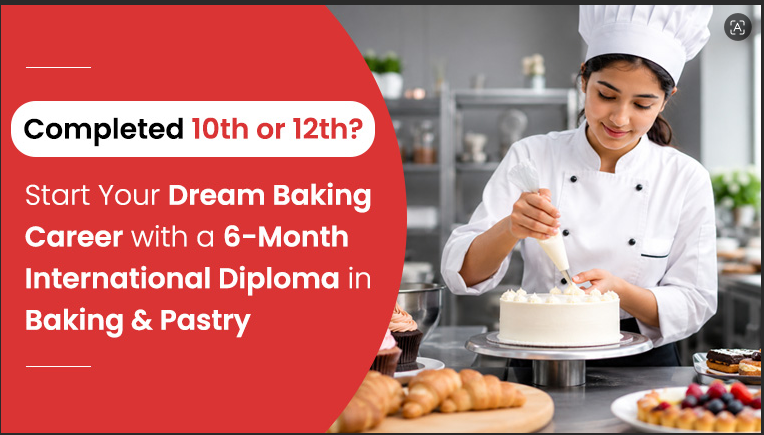

Everyone finishing 10th or 12th gets asked the exact same question on repeat. What next. Engineering, medicine, commerce, the usual list gets recited back at you like there is nothing else on the menu. Nobody really asks the quieter question sitting underneath it, which is what you actually want to spend your days doing. For a fair number of students, the honest answer has nothing to do with any of those options. It has to do with a kitchen, an oven, and the fact that baking is the one thing they have never gotten bored of.
That instinct deserves more credit than it usually gets. A serious baking institute In Chennai can take that instinct and turn it into an actual, employable skill within six months, without needing a college degree first or a detour through a career you never wanted.
This blog is for anyone standing at that exact fork after 10th or 12th, wondering whether baking can really be a proper career, and what a structured diploma actually involves compared to just picking up recipes online.
Why 10th or 12th Is Actually a Good Time to Start
There is a quiet myth that real careers only begin after a degree. Baking does not really work that way. Kitchens care about what you can actually do with your hands, not what year you graduated. Starting right after school means you get a head start of several years on people who spend that same time finishing a degree first and then wondering how to break into food.
Most diploma programmes accept students from 16 years upward, as long as 10th standard is cleared. That is not a loophole. It reflects how the industry itself works. Pastry chefs and bakery owners are looking for people who can bake consistently under pressure, not people with a particular certificate hanging on a wall.
What the 6 Month Diploma in Baking and Pastry Covers
A proper diploma is not six months of watching a chef bake while you take notes.It is eighteen structured modules stacked one after another, each one building on the last. Across those eighteen modules, students work through Viennoiseries, tarts and pies, choux pastry, custards, creams and sauces, sponges, cake decorating, entremets, bread baking, chocolate work, sugar work, petit gateaux, gluten free baking, and the baking science behind why a bake behaves the way it does.
Some of these sound basic on paper, but getting croissant lamination right, or a choux bun that actually holds its shape, takes real repetition under someone watching closely. The more advanced modules push further into territory most home bakers never quite reach, and by the final weeks students are also learning recipe and store management, which is the unglamorous but genuinely useful side of running a kitchen or a small baking business.
None of this happens in isolation. Classes typically run four days a week for around six months, adding up to roughly 350 to 400 hours of actual practice, not passive watching.
Baking Institute Training vs Learning Baking on Your Own
Plenty of people teach themselves the basics from videos, and some get quite good at it. But there is a ceiling to that approach, and most self taught bakers hit it eventually. A video cannot feel your dough. It cannot notice that your butter has gone slightly too warm before you fold it in, or that your meringue is a shade underwhipped.
In a structured programme, an instructor is standing right there while you work. Small mistakes get caught before they turn into habits. You are not just told the right technique once, you are corrected in real time, with your own hands, using your own ingredients, until it actually sticks.
That difference shows up fastest in the technical modules. Tempering chocolate so it snaps and shines instead of turning dull. Getting sugar work to hold its shape instead of collapsing. Building a mousse cake with clean, distinct layers. These are things that genuinely benefit from someone standing over your shoulder saying, not quite, try it this way.
Why an Internationally Certified Baking Diploma Matters to Employers
A recognised diploma carries weight a self taught portfolio simply cannot match, especially when you are applying for your very first job. Zeroin Academy brings ten years of experience training students in professional baking, and its diploma is accredited by the internationally renowned London Academy of Professional Training UK, which signals to hotels, cafes, and bakeries that a student has been trained against an actual international standard, not just self declared expertise. That combination, over a decade of hands on teaching experience backed by internationally recognised accreditation, is exactly what separates it from a short weekend workshop or a scattered YouTube education.
That accreditation opens doors in a fairly direct way. It helps students gain employment in the food industry as a commis, meaning junior chef, or as an assistant chef, right after finishing the course. Beyond that first job, it also gives budding baking entrepreneurs the exposure needed to eventually set up a food business built on international standards, whether that means joining a hotel pastry kitchen, a dessert cafe, or starting something of your own.
Placement Support After Your Baking and Pastry Diploma
A diploma is only half the picture if there is nothing waiting on the other side of it. Find programs that actually help you get into a job and not just give you a certificate and wish you the best of luck.
That support usually includes resume building, mock interviews, internship placements with partner bakeries, and direct job referrals to hotels and established bakery businesses. For students who want to start their own venture instead, good academies also offer mentoring and practical guidance on getting a small baking business off the ground, along with help connecting with banks for loan assistance if funding is a concern.
Is a Diploma in Baking and Pastry in Chennai Right for You
If you have just finished school and baking is the thing you keep coming back to, even after everyone tells you to pick something more conventional, that instinct is worth taking seriously. A hands on Diploma in Baking and Pastry in Chennai gives you six focused months to find out whether this genuinely is your career, backed by real instruction, commercial kitchen practice, and a certificate that actually opens doors afterward.
The oven does not care what your marksheet says. It only cares whether you can bake, and that is a skill six committed months can absolutely teach you.