
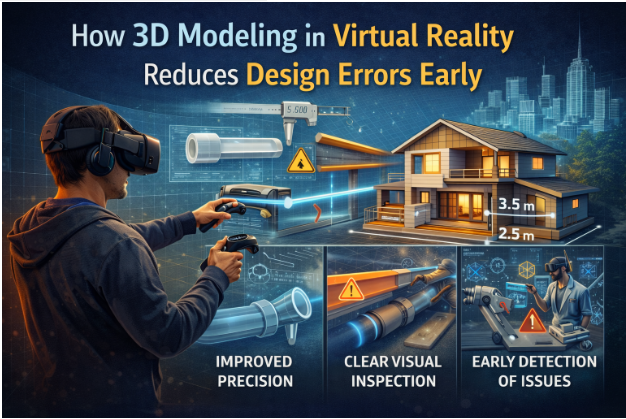

Design flaws represent one of the most prolific reasons for delays or cost overruns in sectors such as architecture, design, engineering, or digital development. In reality, many design flaws are not design-flawed concepts, but rather the traditional design process presents difficulties when it comes to grasping concepts of space or scale in the early design stages. To rectify this problem, 3D modeling in Virtual Reality is becoming increasingly popular as it allows design flaws to be removed at a relatively low price.
Virtual reality impacts error detection by moving it earlier in the process, since it enables users to immerse themselves in the design, which is impossible when viewing it on a two-dimensional surface. This is proactive, which translates to better decision-making, smoother execution, and overall superior results.
The Challenge of Early Error Detection in Traditional Workflows
Traditional design software uses 2D drawings, still images, or 3D views on a computer screen. Although these can be efficient, they also make it necessary for the designer to interpret in their mind the data they see into real-world measurements. This data interpretation can cause many problems.
The kind of problems associated with spacing, proportion, visibility, usability, and alignment are those that remain unseen until late-stage reviews or physical implementation. This impacts design as changes at this point are difficult and expensive. The early identification of these problems needs an intuitive way of reviewing designs.
Uncovering Hidden Issues in Design through Immersive Visualization
In the world of virtual reality, three-dimensional modeling puts the designer right inside the environment. Instead of trying to envision how something might look and feel, this technique allows the designer to live the experience.
Such an immersion enables mistakes to be easily spotted. The constrained paths, proportionality issues, improperly positioned elements, or obstructed views are readily apparent. What could pass unnoticed on a screen becomes apparent through immersion.
Enhancing the Accuracy of Scale and Proportion
Among the most common mistakes in designing is improper scaling. A scale can appear appropriate on the computer screen, but too big or too small when placed in the actual context.
However, the problem of uncertainty in physical proportions in conventional designs and prototypes is eliminated in the virtual reality world, because designers can see designs in a more human-friendly scale, thereby being able to walk through the designs, touch objects, and examine proportions in a natural way.
Identifying Functional/Usability Issues Early
Design is more than just aesthetics. Design also considers functionality. The analysis of usability can be hard to anticipate when abstracted to design.
Immersive spaces enable designers to test how the space would behave as if it were reality. Paths of movement, distances of reach, visibility angles, and comfort zones can be determined in the early stages. Defects or shortcomings in the space regarding its functions can be identified before they cause harm or are eventually remediated in the process of construction.
Eliminating Miscommunication Between Teams
While there are many errors in the design process, the variation in interpretation of the designs by different people involved in the project is a contributing factor. The architect, engineer, or designer, as well as the client, can have a different interpretation of the design.
This allows virtual reality to give a visual clue that everyone understands. Everyone involved being able to view the same virtual reality model helps eliminate misunderstandings. This, therefore, translates to better communication, faster alignment, and less work related to misunderstandings.
Enabling Better Client and Stakeholder Feedback
Clients and other non-technical parties may find it difficult to give effective feedback when looking at traditional drawings. An approval may be required to be revisited later.
By being able to view designs in this immersive setting, concerns can be identified earlier, and feedback can be provided in more detail. It becomes less likely that changes will be made at the end that could be alleviated earlier.
Avoiding Expensive Construction or Production Rework
Errors that are found during the implementation phase are much more costly to correct compared to those that are found during planning.
Design Conflicts, Spacing Errors, Usability Issues
The risk factors associated with early error detection and analysis using immersive visualizations can be minimized. The problems faced during analysis and design can be addressed on the computer, without affecting budgets and timeline, and with the design still being of high quality.
The Function of Technical Knowledge in Reducing Errors
Precise immersive experiences require highly detailed and optimized 3D models. In fact, to guarantee that the virtual environment is a correct representation of the real environment, an organization often enters into a contract with a professional 3D visualization firm.
This knowledge helps keep precision while making sure the execution of performance happens smoothly. A trustworthy visualization enables teams to trust what they see and make informed decisions on the process.
Supporting a Culture of Proactive Design
When teams feel confident that ideas will be vetted completely to their satisfaction in an immersive environment, it encourages experimentation and refinement of those ideas. In doing so, it reduces ideas just being pushed down the line without full vetting.
The process of three-dimensional modeling in virtual reality enables this culture by providing early testing that is accessible, intuitive, and efficient.
Long-Term Benefits Beyond Error Reduction
Minimizing errors in the early stages of design has a cascading effect throughout the entire project. The timelines can be more accurately projected, collaboration enhanced, and the eventual results more in line with original designs.
The same models can also help in later updates and maintenance, as they will increase long-term value addition beyond the use of designs in this phase.
Conclusion
Design errors also tend to be prevalent due to a lack of visibility and the point of validation. These problems with design errors and visibility are addressed by 3D modeling using virtual reality. This enhances the accuracy of scale, understanding of functional problems, and communication. All these factors contribute to the reduction of errors that tend to be prevalent during the early phases.
When combined with the knowledge of a reliable 3D visualization company, virtual reality proves to be an effective method of providing precise, efficient, and high-quality design results. The more complex the project becomes and the higher the expectations rise, the more necessary it becomes to reduce errors in preliminary stages with the help of virtual reality.